
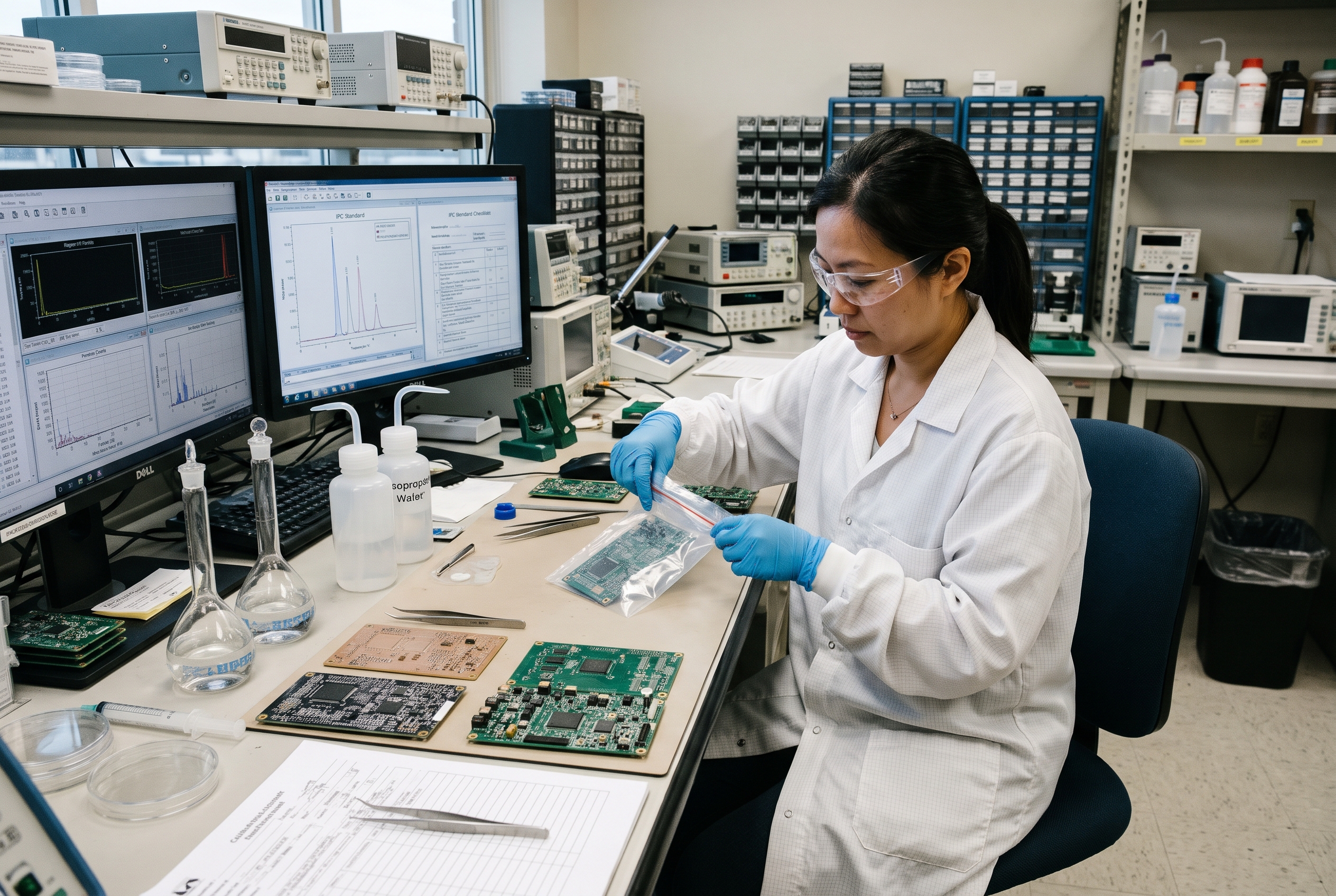
As electronic hardware packs greater computational power and higher operating voltages into ever smaller enclosures, the physical spacing between adjacent copper traces on printed circuit boards has narrowed to fractions of a millimeter. At these tight tolerances, microscopic chemical residues left behind during bare board fabrication, solder mask curing, or component assembly can rapidly destabilize electrical insulation once ambient humidity rises. A pcb test focused on surface cleanliness and ionic integrity is a specialized analytical laboratory evaluation designed to detect, extract, and quantify corrosive residues on both bare laminates and populated assemblies. Verifying chemical purity prior to mass shipment enables electronics manufacturers to eliminate elusive intermittent faults and catastrophic short circuits before products reach end users.
Traditional electrical continuity checks performed at the end of a factory line confirm only that a circuit powers on under dry, room temperature conditions. Diagnostic cleanliness verification looks far deeper, exposing dormant electrochemical contaminants that would otherwise lie hidden until heat and moisture trigger progressive hardware failure in the field.
Electrochemical Failure Mechanisms Prevented by Board Cleanliness Screening
Hidden ionic residues degrade printed circuit reliability through several destructive chemical pathways once electrical voltage is applied.
- Electrochemical Migration and Dendritic Growth: When residual plating salts, etching acids, or unneutralized flux compounds absorb moisture between opposing copper conductors, they form a conductive liquid bridge. Under continuous electrical bias, metal ions dissolve from the positive trace and replate toward the negative trace as fern like metallic dendrites that eventually span the gap and create a dead short.
- Conductive Anodic Filamentation: Inside multilayer fiberglass laminates, aggressive drilling stress combined with trapped ionic impurities allows subsurface copper salts to grow steadily along glass fiber bundles between adjacent internal plated through holes. This hidden internal short circuit often bypasses exterior visual inspection entirely until sudden board burnout occurs.
- Surface Finish Tarnishing and Solderability Loss: Bare circuit boards rely on ultra thin metallic finishes such as Electroless Nickel Immersion Gold, Immersion Tin, or Organic Solderability Preservatives to ensure strong solder joints. Trace chloride or sulfate contamination originating from rinse baths or handling gloves corrodes these delicate pads during warehouse storage, causing weak, brittle solder connections during assembly.
Electronics Industries Dependent on Circuit Board Cleanliness Audits
Routine laboratory verification protects product yields, regulatory compliance, and field safety across mission critical electronics sectors.
- Bare Circuit Board Fabrication Houses: Multilayer laminate manufacturers routinely audit etching baths, electroless plating lines, and final hot water rinse stations to guarantee bare boards ship free from trapped ionic plating chemicals.
- Renewable Energy Inverters and Power Supplies: Solar power converters, uninterruptible power supplies, and industrial motor drives operate under high continuous voltages inside outdoor or humid industrial environments where tight trace spacing demands pristine surface insulation.
- Automotive Safety Modules and Electric Mobility Controls: Battery management boards, inverter controllers, and driver assistance modules face intense thermal cycling and moisture condensation that quickly mobilize residual board contamination into hazardous electrical shorts.
- Medical Electronics and Telecommunications Infrastructure: Diagnostic bedside monitors, implantable device programmers, and outdoor wireless base stations require strict adherence to international cleanliness benchmarks to sustain uninterrupted performance over long operational lifecycles.
Proactively validating bare substrates and finished electronic assemblies shields brands from costly field recalls and unpredictable warranty returns. By scheduling a certified pcb test through an Alstesting Laboratory Testing service in Malaysia, circuit board fabricators and electronics manufacturing service providers obtain the precise, accredited analytical documentation required to certify assembly quality across Southeast Asia and global markets.
Frequently Asked Questions (FAQ)
How does Ion Chromatography compare to traditional ROSE testing for circuit boards?
Resistivity of Solvent Extract testing washes an entire board in an alcohol water mixture and measures only a single bulk electrical conductivity value, which cannot identify specific chemicals or pinpoint localized pockets of contamination under fine pitch components. Ion Chromatography separates and quantifies individual corrosive species such as chlorides, bromides, sulfates, and weak organic acids, delivering actionable root cause data that modern cleanliness standards require for process qualification.
Why should bare circuit boards be tested for cleanliness before assembly begins?
If incoming bare printed circuit boards already carry elevated levels of plating bath salts or solder mask residues from fabrication, even a spotless soldering process cannot prevent downstream reliability failures. Screening bare boards during incoming quality control confirms whether contamination originates from the laminate supplier or from the assembly line.
What is Surface Insulation Resistance testing and how does it complement ionic analysis?
Surface Insulation Resistance testing monitors electrical resistance across specialized comb pattern test coupons placed inside a high temperature, high humidity chamber under continuous electrical bias. While ionic chemical extraction measures the exact quantity and identity of surface contaminants, Surface Insulation Resistance confirms directly whether those residues remain electrically benign or actively trigger leakage currents under harsh environmental stress.


